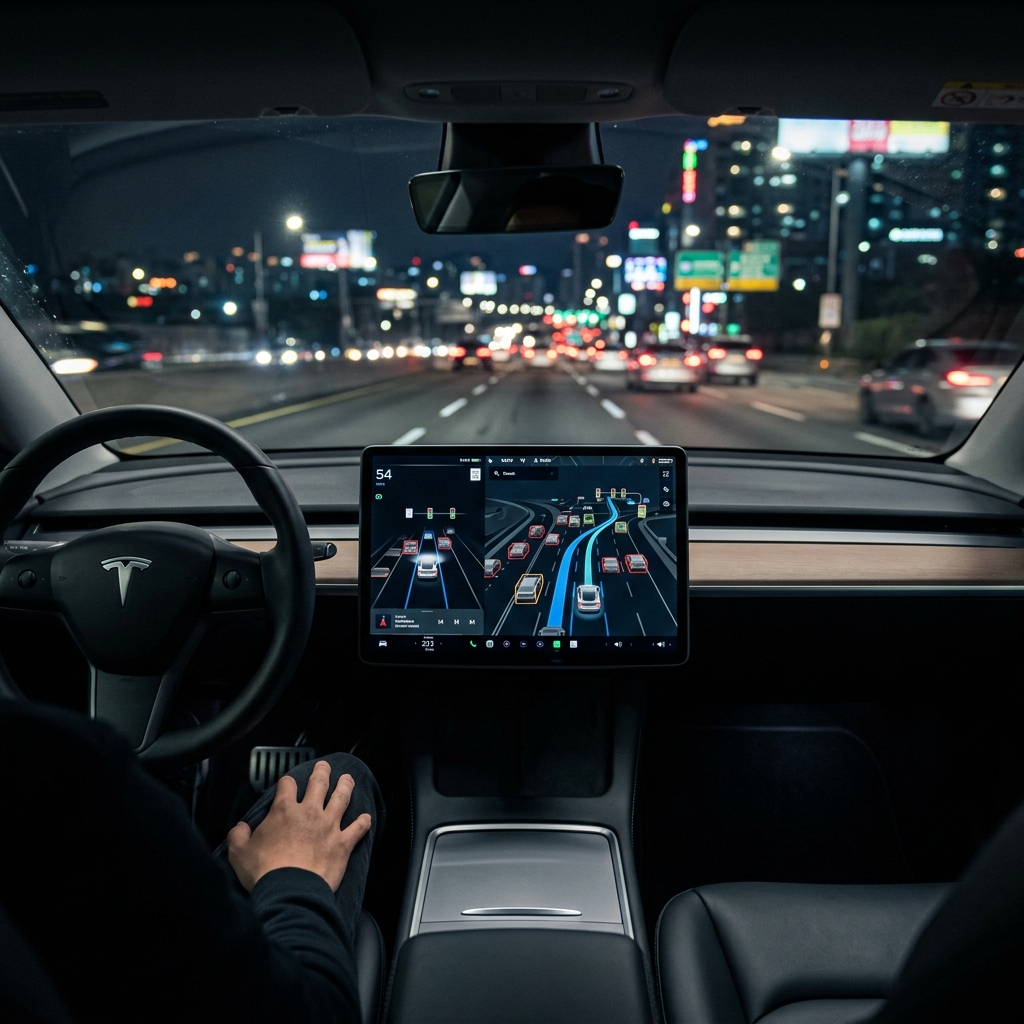
For nearly half a decade, Tesla owners were reassured that the vehicles they purchased—equipped with Hardware 3 (HW3)—possessed all the necessary computation power to eventually achieve full, unsupervised autonomy. However, the laws of physics and silicon scaling have finally caught up.
Tesla has officially confirmed that Unsupervised Full Self-Driving (FSD) will target a Q4 2026 release running exclusively on AI4 (Hardware 4) and future AI5 hardware.
For the roughly 4 million HW3 vehicles currently on the road, the autonomous future has suddenly acquired a hard technical ceiling. While HW3 vehicles will continue to receive safety updates and a specialized, lightweight version of Tesla’s neural network, they are officially locked out of the upcoming driverless robotaxi era.
If you are an HW3 owner, you are likely wondering what this means for your vehicle’s residual value, its software lifespan, and your path forward. Below, we break down the technical bottlenecks that forced this decision and analyze the three best options available to HW3 owners today.
The Technical Bottleneck: Why HW3 Was Left Behind
To understand why HW3 cannot cross the chasm into Unsupervised FSD, we must look at the sheer scale of Tesla’s next-generation neural networks.
Tesla’s upcoming FSD v15 architecture represents a complete paradigm shift. The system is transitioning from a 1-billion-parameter model to a massive 10-billion-parameter model. Running a model of this magnitude requires a monumental amount of onboard memory (RAM), memory bandwidth, and raw compute performance (measured in TOPS, or Trillion Operations Per Second).
| Specification | Hardware 3 (HW3) | AI4 (Hardware 4) | AI5 (Hardware 5) |
|---|---|---|---|
| Inference Compute | ~72 TOPS | ~300 TOPS | 2,000 – 2,500 TOPS |
| Silicon Node | 14nm (Samsung) | 7nm / 5nm class | 3nm / 4nm class |
| System Memory | 8 GB LPDDR4 | 16 GB LPDDR5 | High-bandwidth Next-Gen |
| Peak Power Draw | ~100 Watts | ~160 Watts | Up to 800 Watts |
| Camera Resolution | 1.2 Megapixels | 5.0 Megapixels | Ultra-HD Hybrid Weatherproof |
| Unsupervised FSD | No (Capped at Supervised) | Yes (Targeting Q4 2026) | Yes (Native / Robotaxi Ready) |
HW3’s custom-designed FSD chip, fabricated on a 14nm process, tops out at approximately 72 TOPS of compute and is constrained by a modest 8 GB of system memory. AI4, by contrast, boasts a 20-core processor, roughly 300 TOPS of compute, and a crucial 16 GB of high-speed memory.
Simply put, the 10-billion-parameter FSD v15 model cannot fit within the memory buffer of HW3 without crippling its processing speed. While Tesla’s AI team has successfully used “distillation” techniques to shrink previous models, v15 represents an architectural step too far for the aging 14nm silicon.
Option 1: Accept the “v14 Lite” Maintenance Lane
For owners who have no desire to ride in a driverless robotaxi and are content with steering-wheel-prompted “Supervised” autonomy, the most cost-effective option is to do nothing.
Tesla is not abandoning HW3 entirely. Instead, the company is preparing a specialized, stripped-down firmware branch known as FSD v14 Lite.
What is FSD v14 Lite?
Expected to roll out to the fleet, FSD v14 Lite is a highly distilled, compressed version of the v14 neural network optimized specifically for the compute constraints of the 14nm FSD Chip.
- The Pros: You retain the ability to use FSD (Supervised) for highway and city driving. The system will continue to receive critical safety patches and minor navigation updates.
- The Cons: You will be driving in a permanent “maintenance lane.” The system will lack the advanced spatial awareness, high-speed decision-making, and end-to-end performance of the full v14 and v15 models running on AI4.
Note: If your primary use case is highway commuting under human supervision, the HW3 platform remains highly capable. However, the gap in driving smoothness and safety margins between HW3 and AI4 will continue to widen over time.
Option 2: The Retrofit Path (Computer and Camera Upgrades)
To appease early adopters who purchased the full FSD package under the promise of future autonomy, Tesla has announced a hardware upgrade path. This path involves upgrading the HW3 computer and camera suite.
However, this is not a simple “plug-and-play” swap to standard AI4 hardware.
Because AI4 vehicles utilize completely different wiring harnesses, higher-voltage power delivery systems (AI4 draws up to 160W compared to HW3’s 100W), and different physical mounting footprints, a direct drop-in of an AI4 computer into an older HW3 Model 3 or Model Y is physically impossible.
Instead, Tesla’s retrofit path is expected to consist of:
- Upgraded Camera Sensors: Swapping the older 1.2-megapixel camera modules for higher-resolution sensors that match the optical characteristics of the AI4 suite.
- A Specialized Retrofit Computer: A custom “node” designed to fit the physical and thermal constraints of the older chassis while offering enhanced neural processing units (NPUs) and expanded memory capacity.
Is the Retrofit Worth It?
If you already own the FSD capability outright, Tesla may offer this upgrade at a heavily discounted rate—or potentially free of charge in select regions to satisfy legal definitions of “Full Self-Driving.”
However, if you have to pay out of pocket, the labor and hardware costs of retrofitting cameras and computers could easily run into thousands of dollars, making it a less appealing option than trading in the vehicle.
Option 3: The Discounted Trade-In Route (Upgrading to AI4 or AI5)
For owners who want true, Unsupervised FSD as soon as it launches in late 2026, trading in your HW3 vehicle for a newer model is the most seamless path forward.
Tesla is actively preparing discounted trade-in opportunities and loyalty incentives specifically targeted at HW3 owners looking to transition.
[Your HW3 Tesla] ---> [Tesla Trade-In Incentive] ---> [New Model (AI4 / AI5)]
                                                            │
                                                            └──> Model 3 Highland (AI4)
                                                            └──> Model Y Juniper (AI4)
                                                            └──> Cybercab / AI5 (Future)
What to Buy Now: Model Y “Juniper” or Model 3 “Highland”
If you choose to upgrade today, any new Model 3 (Highland) or Model Y (Juniper) comes standard with the AI4 hardware suite.
- Model Y Juniper: Featuring a refined interior, improved acoustic dampening, and native AI4 integration, the updated Model Y is the benchmark for modern EV utility.
- Model 3 Highland: Offers exceptional efficiency, upgraded suspension, and a whisper-quiet cabin, fully optimized for the AI4 camera angles.
Should You Wait for AI5 (Hardware 5)?
Tesla’s next-generation AI5 platform is slated to begin limited production for consumer vehicles in early 2027. Boasting an incredible 2,000+ TOPS of compute, a massive 800W power draw, and Samsung’s weatherproof hybrid heated lenses, AI5 is designed from the ground up for the Cybercab and true, steering-wheel-free robotaxis.
However, waiting for AI5 means delaying your purchase by at least 12 to 18 months. Because AI4 is officially confirmed as the target hardware for the Q4 2026 Unsupervised FSD rollout, buying an AI4 vehicle today guarantees you a spot…
Note: This section was auto-completed after a truncated publish. Verify live Tesla terms on Tesla.com before ordering.
Editor’s Resource
If you are planning to purchase a new Tesla vehicle or home energy system, order through our official referral link (https://ts.la/mate59032) before checkout to unlock current buyer benefits (typically 3 months of Full Self-Driving (Supervised) on eligible vehicles, or about $400 off qualifying Solar). Referrals are not retroactive.
Related: Tesla referral code 2026 · How to use a Tesla referral code · Tesla referral code 2026
Ordering a new Tesla or Energy System?
Use referral code mate59032 at checkout to unlock current buyer benefits—typically a Full Self-Driving trial or Solar discount. Apply the link before you order.